Showing posts with label economy. Show all posts
The Fed is acting.  Just look at this plot. Never mind understanding it at first, just look.  That's what the Fed owns.  The big picture is "something's up!" I'm trying to understand what, in more detail.

First of all, there's a companion liability picture.  That one, (they're both on wikipedia's Fed. Budget page)  matches, so assets = liabilities.  The new matching liabilities that paid for these things are owed exclusively to the Treasury and preponderantly to depository institutions. The Fed bought bad debt from big banks, with what money I'm not sure.


Here's how you make money, Romney style:

You start with a little seed money, and a company you're going to buy for collateral,
...you get a company sized loan,
...pay the old CEO some hush money (get the $ from the loan)
...and pocket a big chunk of the money (34% is what they like).

The company you see is responsible for the loan: they have the new loan payments to make.

Then for a while, you get to play CEO, do some firing, close some plants, see if you can make it go!

The company meanwhile has taken all the risk, and it's a body blow. They have a $100 loan to service, and $50 worth of capital.  (or maybe it's $100 million: the numbers are just representative.) Suppose they just try to pay it off: they're $50 short! Thus the net outcome is a new debt for the company to make payments on, all of which was essentially awarded as a bonus to the new owners.

It's so immoral, it's almost psychopathic.

This was the plot of the 80's movie, "Pretty Woman."

Econ: half baked, so far. Stay tuned.

Economics heats up in an election year. Here are MY thoughts.

(1) I believe the Fed is mostly a good thing, the gold standard is silly. Gold's a commodity like anything else, and pegging money to it creates volatility: a bad thing. It's just playing craps.  What's the ideal money? One where prices are fixed: $1 for a hamburger, now and forever.  That's oversimplistic of course, we should use some average (eg Consumer Price Index) but you get the picture. The way to do that is to adjust the money supply.  For instance, money supply has to grow if the economy does, lest all the new people making all the additional hamburgers cause deflation!

The Fed goes beyond "pure" constancy, seeking a moderate (2%) inflation. It's important to note inflation is under control.  I don't mean that in the sense of "it's low" but in the sense of literally responsive to stimulus in ways we understand and can affect. That's what a control "system" is and arguably the US inflation control system operates pretty well.  We could argue all day about what the inflation rate Ought to be, and we should, but that's another topic.

Note the Fed can control inflation without impact on US Government debt.  No one has to issue  a T-bill for the Fed to buy one.  Heck right now (QE3) they're buying ordinary assets: home loans. No debt is being created, just adjustment of the money supply.

One thing I'm ignorant of and interested in is the Fed motivations. What creates and ensures their altruism? Under what pressures are they to do the right thing and can those pressures become overweening? For instance, a lot of those mortgages they're buying under QE2 are going to turn out to be bad debts and the Fed will lose money on this deal. What are the consequences of losing money when you can just print more?  None is my simpleton's answer. If somebody can offer a more nuanced explanation I'd like to hear it.

One thing that will surely happen is that the banks, like Katrina victims with a fat insurance check in their pockets, will go right back and build more houses with potentially unchanged risk aversion. That safety net aspect of selecting (possibly distressed) mortgage assets seems a questionable choice to me. If we're stepping away from t-bills, how about buying up windmill farms, or public schools or something else we really want to encourage?

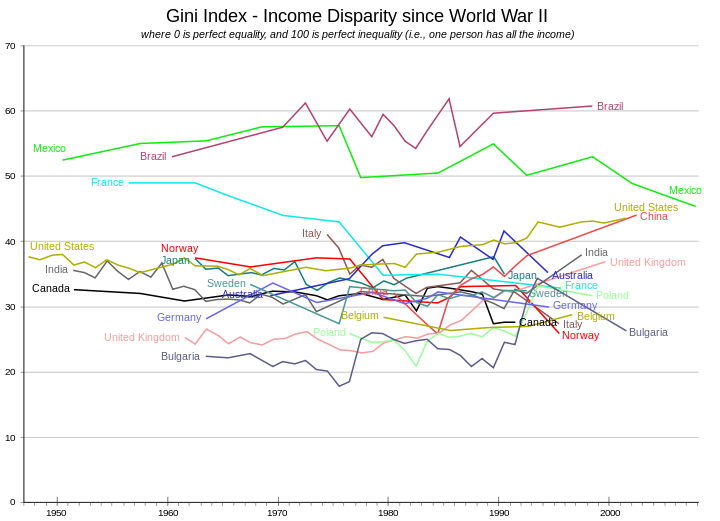
(2) Gini  The Gini coefficient is a measure of income concentration and the US trend is pretty bad and getting worse: look at our cohort: we're in a dead heat with China, aiming to overtake Mexico any minute.

Mitigating this grim fact somewhat is our ageing population, which demographic skews the answers as they retire but (unlike worse off countries) live on. I'd like to see a Gini coefficient calculated based on wealth instead of income. Of course, it's a big internet, and so here it is!  You can sort the list with a click and find the US is the WORST except for Namibia, Zimbabwe and Switzerland, though we have the highest per capita wealth except for city-states Hong Kong, Luxemburg. (It's $143k, if you care, but those are jiggered currency trying to normalize across all currencies.) In the US, you can see below that the wealth gini exhibits much larger disparity than the income gini.


I'm opposed to this oligarchy and thus in favor of high inheritance tax. I agree you should get to benefit from the fruits of your labor, but maybe not your parents'! You should get what you deserve not what They did eh? This explodes the hypocrisy of many.  A similar argument leads me to capital gains taxes. (A sense of fairness says, you don't labor for your capital gains.) Perhaps most importantly, I feel tax policy is the lever to control Gini Coefficient, just as Fed monetary policy is the lever to control inflation. We should argue about Gini, just like inflation, and then act positively to affect it. Right now the concentration is high and increasing, so the tax code should be more progressive. This seems pretty cut and dried to me.

Diamond vs Tainter


@Adam: I'm also very interested in the Tainter/Diamond comparison.

Diamond sez Tainter sez "how could you not anticipate a problem & fix it?" It's a fair assessment of some quotes from The Collapse of Complex Societies. (I linked my review.)
From that conundrum Tainter goes on to describe a dynamic (this oft mis-used word fits precisely here)wherein the society enjoys a benefit of technological progress, grows to consume the benefits, & thereby becomes irrevocably committed to it.  Tainter adds that more technology, our only solution (eg to world hunger) may actually not work because of diminishing returns.

This is a fancy way of saying "didn't see it coming"  so when Diamond cites that cause, he's agreeing with Tainter. Diamond divides and enumerates while Tainter tries to understand why. Both are forms of analysis, but not equally good. Diamond is exceedingly thorough, but fundamentally shallow. While both latch on to human self interest as impediment to doing the right thing, Diamond has only "didn't see it coming" and "tragedy of the commons" for rationale, though he takes a dozen pages to say it. Maybe I should say he takes 500 pages to say it! Tainter’s cause is far more nuanced, and complex enough to be the rationale for not foreseeing or effectively mitigating a problem, even if you wanted to.

Tainter’s approach is so tricky that he himself cannot explain it succinctly and instead has to spend much of the book illustrating the problem, carving away around the edges to indirectly describe it’s core. Thus, I’m sorely challenged to pack it in a nutshell! Here’s a try...

Tainter draws an arc of diminishing returns from technological investment that eventually flattens out entirely and then slopes downward!  How could this be?  Adam, I think you’ll like my answer that it’s essentially because of externalities. The accurate cost/benefit analysis in determining whether to buy the latest fertilizer is miscomputed by the farmer because the numerator is misquoted to him in the form of an incomplete accounting behind the price tag. Somewhere the last island of bat guano is being strip mined to make that cheap fertilizer, which lets Iowa support a larger population which intrinsically requires the higher crop yield. The people have to eat. The tractor has to eat. The people move off the farm and build iPods and strip mining machinery Then one day the fertilizer runs out.  Not so different from the last tree on easter island, but you can more easily see how it could sneak up on you. It's just the tragedy of the commons again, made indirect, far away and invisible.

Tainter would probably amplify on my example by describing interconnected webs of dependency, more fragile and less obvious than the fertilizer one. Have you heard Greenspan’s stump speech about the latte? (worth googling) A latte for a couple bucks is a triumph of technological society. Not so long ago, only royalty could aspire to such a concoction and now we all can, but it’s supporting infrastructure is not robust to challenge.   A big steel boat is efficient, but fragile. Put a hole in your wooden dinghy and at least it will still float and you with it.  

Why do we go over the cliff?  Why can’t we retrench to sustainable levels when something complicated gives way? Why are crisis and collapse required?  


Momentum.

When more children are born in Greenland and more outfield flayed to make their houses. You could go back, but some of those children would have to starve. I think Tainter would say the technology itself comprises the momentum, not just the bellies, but I can’t quite defend that part.  Can’t I un-commit to technology?

You can’t just rescale us without a nonlinearity.  There's this thing, the "back side" of the power curve.  There's a minimum drag point, fly faster or slower and you need MORE thrust.  Fly a little slower, add a little thrust, do that for a bit and you're in a tough spot because now it's unstable: if the thrust drops even just a little you can't get back to the normal linear range but instead will slow down until the nonlinearity: stall.  There's a solution in the airplane example just as there is in real life, but it's painful: you have to give in to the inevitable, dive and lose altitude (lose luxury, sacrifice population) to slide down to a sustainable situation.  This is a pretty good analogy, and the Lift-Drag curves even match Tainter's curves in the book.  

Maybe Tainter is wrong about a crystalline web or a house of cards: these are compelling images but are they apt?  What if the rubber supply for my espresso machine’s gasket fails? An alternative silicon gasket can get designed and produced in no time. Hell I’ve already got one. (a spare, actually. I can’t survive an espresso interruption, and after these doomsday books, I’ve taken steps.) Maybe our web of interdependence is resilient like a spiderweb, not fragile like ice, and surely it’s organic and self healing in the sense of trying to grow new bonds where there’s a need. Technology is our religion, a groundless belief that some nerd will invent a new kind of fertilizer and we’ll all be fine.  Even this example isn’t notional. Goog the story of the “Haber Process,”  wherein a smart boy invents a machine to make bat guano.  So maybe Tainter is wrong. Maybe this time. But that machine of Habers? It makes bat guano out of oil.

I like Diamond’s points, a lot. I agree with him.  But I never read a book before and said “duh” so many times.   Analysis by dissection is a tool but it’s too ponderous and just cutting stuff up into little bits doesn’t ADD anything. Tainter made me think & I’m still thinking.

Tribal Economy

Just listened to NPR's Planet Money on "the Past and Future of American Manufacturing."  It was quite a distressing podcast lamenting the loss of manufacturing jobs, wondering how good but unskilled laborers would fare in the future where manufacturing is about finesse and programming, not stamina.  The host, right after being told he would never be hired to program NC milling machines, wondered how the show's protagonist, a hard working aggressive young mom named Matty, could ever get uptrained.  The fearful conclusion was she wouldn't.

It's ironic how Adam Davidson worried about Matty's future, right after being told he himself also had no chance at that job either. I don't think getting everybody "trained up" to operate an NC mill is either needed or practical. We really do need only 1/100 as many combine drivers as scythe swingers. What an astounding efficiency gain! As they poignantly illustrated, there's tragedy here, because the machines have CREATED value, so overall life for everyone should be easier,, not tougher. Nor do I believe is it as simple as, "well there're are more of us now so the times are just as tough as ever."  Here's an illustrative fable.

--------

Thor paused, sweating.  His log was the biggest and he was in front, but he didn't need to rest.  The stop was because Ting the chief had just showed up on the crest of the next rise leading 4 of those strange new animals, "horses."  What would happen now?

The tribe was half way through their annual migration. Each year, the women built travois' and hauled the family's tent and few goods some 200 miles from the rich timberlands up north down to the arid grasslands.  The men hauled timber.  These logs were prized material to make bows & tentstakes among the hunter gatherer tribes of the south, and they'd trade food and furs that made the trip a productive annual event for the Ting tribe.  Some rich chiefs even had astounding "tents" made entirely of tree slabs stacked close, to keep out every whisper of icy wind.  They were luxuriously comfortable: the demand for the tribe's product seemed limitless.

Now old Ting had horses. He was even riding one.

"Thor," he said, looking down at his strongest haulsman while the others came up , variously puffing or wheezing according to their exertions and the ambition of their load, "things are gonna change around here."

"How, lord Ting?"

"We've got horses now.  We don't need all you men pulling.  A horse can haul as much as 3 men, and feeds itself along the way, so your job ends right here, on this hilltop.  From now on, your wife will ride, you can pull her travois with the tent on it."

"I can go twice as fast pulling that little thing.  Who'll keep up with me?"

"Well," Ting said, "the horses will be heavily loaded, so we won't go faster, but instead we'll just have more logs to sell.  If you get too far ahead each day, maybe you can do a little fishing, or nap.  Whatever."

~ ~ So, that's how it COULD have gone.  But as you know, on that day Ting instead left most of his tribe to fend for themselves. He had a horse and that made him rich and put the rest of the tribe out of business.  That pretty much set the pattern for the rest of history.

Why doesn't the largess of our technological advance translate into a more idyllic lifestyle for everyone?  

It's easy to do the "energy balance" and see that tools, animals, machines and oil have each multiplied our ability to get things done. These should have the effect increasing the potential leisure and comfort, supporting a greater population, or some combination of those. That we always choose option #2 seems like a problem in our programming.

Even if we preferred leisure over consumption, there is still a problem of distribution.Everyone needs to benefit from the technological improvement, but ownership tends to concentrate, as the return on investment allows Ting (and nobody else) to buy another horse. Would stock ownership allow the little guy to buy a small piece of the technology? Why hasn't that worked.?

If ancient Norse beer technology advancements doubled yield, why couldn't everyone just have two?  It seems a simple calculation, but maybe it's the problem as well. First of all, everybody has to increase their consumption to keep full employment or, in the case of items with intrinsically limited demand (ok so not beer, but there must be something...) the technological advancement, whether the horse or the automated brewery, brings a reduction in employment as a nominal consequence.

 The benefit is the commodity price drops thanks to lower labor, but what's the laborer supposed to do?  You obviously can't put the reduced price genie back in the bottle, nor is dragging logs by hand any longer a viable livlihood. You can't compete with a horse just as John Henry couldn't compete with a steam hammer. Is a requirement for growth the consequence of advancement?  Cold bloodedly, in the absence of consumption growth, starvation will eventually balance the labor market to the need. More hopefully though, assuming constant GDP (same number of logs dragged) a pair of hands has been idled, that's potential to create more wealth for us all to share. That's if we can gracefully repurpose and retask the displaced individuals, but why not?  Humans are flexible creatures. Maybe now Thor will carve totem poles the plainsmen can afford to buy since logs are cheaper. This is growth.Is there a problem?  Well, maybe. Another stable balance would involve MORE plainsmen consuming all the logs that could be supplied even with horses. Everybody's still pulling for all they're worth.  Subsistence, only more of it. This scenario need only arise if we wastefully expend every technological windfall in the name of more human mass until (see Collapse of Complex Societies) we are dependent on all the latest gizmos just to get by. Problematically, it seems the natural outcome.